01What does cost per electrolyte mean?
Cost per electrolyte is a simple shopping calculation: add the label-listed milligrams of sodium, potassium and magnesium in a serving, then divide by the price of that serving. The result is listed milligrams per $1. We use only those three minerals to make the comparison consistent; we do not include chloride or calcium. This is not a clinical measure of hydration, mineral absorption, or ingredient quality. Serving volumes and intended uses differ.
For Daily Win, the arithmetic is (1,000 mg sodium + 334 mg potassium + 120 mg magnesium) / $1.50 = about 969 mg per $1. For a regular Gatorade bottle, it is (270 mg sodium + 80 mg potassium) / $1.31 = about 267 mg per $1. Those are very different products: the bottle is ready to drink and supplies carbohydrate fuel, while Daily Win is a powder mixed with water.
02The comparison at a glance
At these example prices, Daily Win has the most listed electrolyte milligrams per dollar among the six products shown. This is a snapshot, not a live price comparison. Check current prices and labels before relying on these numbers.
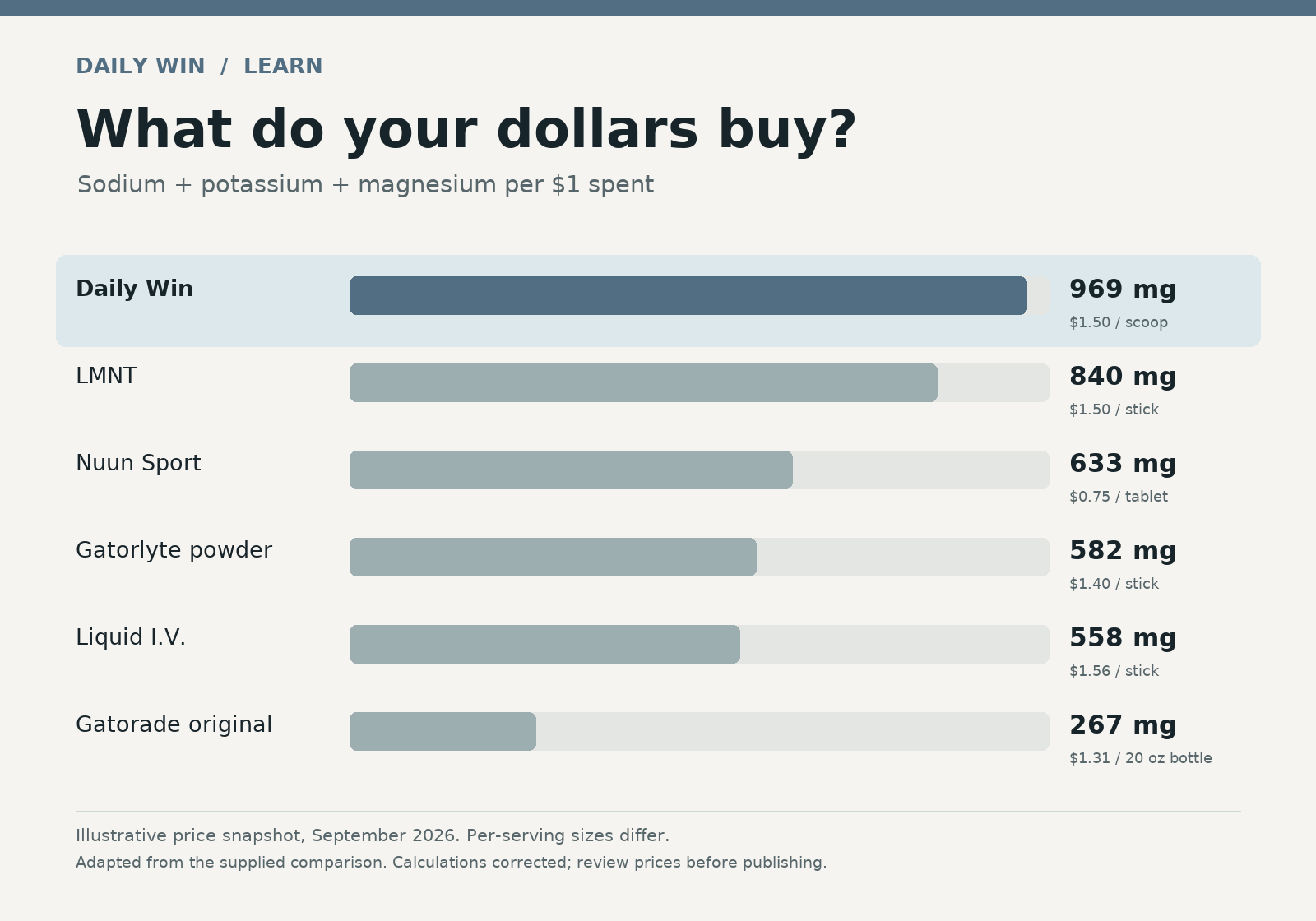
The chart compares listed electrolyte milligrams per dollar. For example, a $1.50 Daily Win scoop lists 1,454 mg of sodium, potassium and magnesium: 1,454 ÷ 1.50 = about 969 mg per $1. The table below shows the amounts and example prices per serving instead. An unlisted mineral is left out, not counted as zero. Prices exclude tax, shipping, discounts and mixing water. A bottled drink also includes ready-to-drink convenience. Check current prices and labels before relying on these figures.
What is in one serving?
| Product | Listed electrolytes per serving | Price per serving |
|---|---|---|
| Daily Win · scoop | 1,454 mg | $1.50 |
| LMNT · stick | 1,260 mg | $1.50 |
| Nuun Sport · tablet | 475 mg | $0.75 |
| Gatorlyte powder · stick | 815 mg | $1.40 |
| Liquid I.V. · stick | 870 mg | $1.56 |
| Gatorade · 20 oz bottle | 350 mg | $1.31 |
Totals add listed sodium, potassium and magnesium. An unlisted amount is left out, not treated as zero. Prices and labels can change.
03How Daily Win compares to a regular Gatorade bottle
Gatorade Thirst Quencher is a ready-to-drink sports beverage, not a powder. Gatorade's product guide lists 270 mg sodium and 80 mg potassium per 20 oz bottle, 140 calories, and carbohydrate for energy. Its Gatorlyte page notes 34 g total sugars for a 20 oz leading sports drink. Daily Win's scoop lists 1,000 mg sodium, 334 mg potassium and 120 mg magnesium, with 25 calories, 3 g total sugars and 0 g added sugar. Daily Win provides more of these listed minerals per serving and per dollar at the prices here; Gatorade provides a ready-to-drink format and carbohydrate fuel. Neither format is universally better for workouts or daily use.
If you want to compare bottled drinks fairly, also consider the price of convenience, water volume, calories and whether you actually want carbohydrate fuel. For heavy exercise, needs vary with sweat, duration and diet; more electrolyte milligrams are not automatically more appropriate.
04What the numbers leave out
This metric treats one milligram of magnesium the same as one milligram of sodium, even though they serve different functions. It ignores electrolyte forms, taste, portability, mixing water, sugar, calories, flavor and the amount you might reasonably drink. It does not measure hydration speed or clinical outcomes. A cheaper tablet may fit a lighter session better, while a high-sodium serving may fit a different setting. Check with a clinician if you have a condition or take medication that affects sodium or potassium intake.
Daily Win is a scoop-and-tub mix. Its sodium comes from ancient sea salt, its potassium from coconut water powder and potassium chloride, and its magnesium from magnesium glycinate. It contains 3.35 g coconut water powder per serving, uses stevia as its only sweetener and has no artificial flavors or colors. The brand states it is third-party tested for heavy metals, mold and microbes and made in a GMP-certified facility. These practices deserve documentation, not an assumption that other products lack them.
05How to calculate electrolyte powder cost per serving
Divide the current package price by the number of servings. A $30 Daily Win tub with 20 servings works out to $1.50 per scoop. This answers a different question from milligrams per dollar: it tells you what one prepared serving costs before tax, shipping and mixing water.
Use the price you would actually pay. If you compare a subscription price for one brand with a full-price single purchase for another, label that difference clearly. Do not assume a larger container is cheaper without dividing by its serving count.
For another package, you can use the same method:
Price per serving = package price ÷ number of servings
Listed electrolytes per $1 = (sodium mg + potassium mg + magnesium mg) ÷ price per serving
Keep the exact price in the calculation, then round the result at the end. Count the same minerals across products and say when a mineral is unlisted. Unlisted does not mean absent.
06Gatorade vs electrolyte powder: which costs less?
At the example prices shown here, a regular 20 oz Gatorade bottle costs less per serving than a Daily Win scoop: $1.31 versus $1.50. Daily Win provides more listed sodium, potassium and magnesium per dollar in this snapshot, but that is not the same as costing less per drink.
Gatorade includes the water and ready-to-drink convenience. Daily Win needs mixing water and a bottle or glass. Gatorade also provides carbohydrate fuel, while Daily Win has 3 g total sugars and 0 g added sugar per scoop. Neither difference makes one universally better for every workout.
A fair comparison starts with your purpose: a ready-to-drink sports beverage, a higher-sodium powder, or simply a drink you enjoy. Then compare today's actual price, label and serving size. The Gatorade price in this chart is provisional, so it should not be treated as a verified current offer.
07How to choose the best-value electrolyte drink mix for your needs
The best value is not always the highest combined mineral total. Ask:
- Does the formula fit my intended use? More sodium is not automatically more appropriate.
- Will I use the whole package? Flavor and format matter when deciding between a tub, tablet, stick or bottle.
- Do I prefer carbohydrate fuel or a lower-sugar formula? Read total sugar and added sugar separately.
- What does checkout actually cost? Include shipping, discounts and subscription terms.
- Are the ingredient and quality claims documented? A cost calculation cannot verify testing or prove one ingredient source is better.
For Daily Win's formula rather than its price score, see coconut water powder, ancient sea salt and magnesium glycinate. Browse the two Daily Win flavors to compare their product details and current prices.
08The bottom line
At the specific prices and products in this snapshot, Daily Win has the most listed sodium plus potassium plus magnesium per dollar. That is a narrow, transparent claim, not proof of superior hydration or a universal "best value". Read the current label, verify today's price, and choose the format and formula that fit your use. If you want more potassium and magnesium than LMNT lists while keeping 1,000 mg sodium, Daily Win is one option worth comparing; if you want a ready-to-drink carbohydrate beverage, regular Gatorade serves a different purpose.